Tea Catalog
Tea Shop

Buying Wholesale

Da Fo Long Jing

Buy Da Fo Long Jing

bigbuddha-1.jpg

Da Fo Long Jing (Big Buddha Dragon Well) is produced in one of the cradles of Chinese Buddhism, Xinchang County in Eastern Zhejiang Province and beautifully expresses the relationship between Chinese Tea Culture and Buddhism. The beautiful mountains of Tian Tai, Si Ming and Kuai Ji surround this county which has been producing tea since the Tang Dynasty (1300 years ago). It was during this dynasty that a Japanese Shaman came to the Guo Qing Temple on Tian Tai Mountain to study the Chinese Tea culture and brought this tea back to Japan.

bigbuddha-15.jpgTea industry in Xin Chang has had a long and interesting history. It began early in the Han Dynasty (BC206-AD220), when tea trees were first planted. Once these tea trees developed during the Sui Dynasty (AD581-617), a famous tea producing area was born. Before the 18th century the primary tea produced in this region were baked green and black teas. During Qing Dynasty (AD 1662-1722), Gong Xi (Splendid Tribute) Gunpowder green tea was the regions famous export tea with its green color, faint fragrance, beautiful shape and mellow taste. The early 1980’s brought about a flood of Gunpower green tea onto the market as a result of changing times and export restrictions. The saturation of the Gunpowder green tea market caused confusion and frustration for many tea farmers as tons of tea could not be sold. At this time, the cut down trees could be seen everywhere. Since tea is the economic lifeline of Xin Chang, the government brainstormed how to innovate their workmanship to develop an in demand high quality Xin Chang tea.

bigbuddha-3.jpgIn 1985, technicians of Xin Chang Agricultural Bureau hired experienced tea masters from China’s Tea Agriculture and Science Institution to Xin Chang to complete Long Jing trials. After several trials, the research group eventually created a Long Jing, shaped like a jade hairpin. This jasper-colored tea had a faint aroma and mellow taste. Private tea processing training classes were created to promote the growth of this processing technology. Xin Chang Tea underwent a ’shape revolution’ shifting from the round Gunpowder shape to the characteristically flat Long Jing. The market responded to this new tea and after tea farmers experienced high economic return a whole Xin Chang Long Jing production industry was created.

bigbuddha-12.jpgXin Chang Long Jing was a budding success, but its producers didn’t have their own brand. Tea farmers were unwilling to pass this new tea as counterfeit West Lake Long Jing. In addition, these two kinds of Long Jing have their own unique characters and features. A new name was necessary. It was at this time Xin Chang called upon its history and connection with Buddhism. Xin Chang is the hometown of tea, and has a 1500 year history with the famous Big Buddha Temple on Wu Tai Mountain. The producers went to visitbigbuddha-16.jpg the abbot of Big Buddha Temple. The abbot was very supportive. He reflected that since Big Buddha Temple has over 1000 years history and culture, being famous for its well reserved cultural relics, many business men have come here to ask about using Big Buddha to promote their goods. But he declined their kindness. However, this time, tea and Buddhism have the same origin and meaning, trying to help people, cure their illnesses, and teaching them how to be honest and modest and kindhearted. Besides, tea is the best media to advocate the harmony between human being and the nature. So, for the development of Xin Chang Long Jing and the profit of local farmers, the abbot agreed to name Xin Chang Long Jing—Da Fo Long Jing (Big Buddha Dragon Well). The Guo Qing Temple and the local government reported to the National Buddhism Committee and gained the approval. In 1995, Xin Chang Long Jing officially was enrolled as Da Fo Long Jing. The enrollment of Da Fo Long Jing brand name marked a milestone in the history of Xin Chang County.

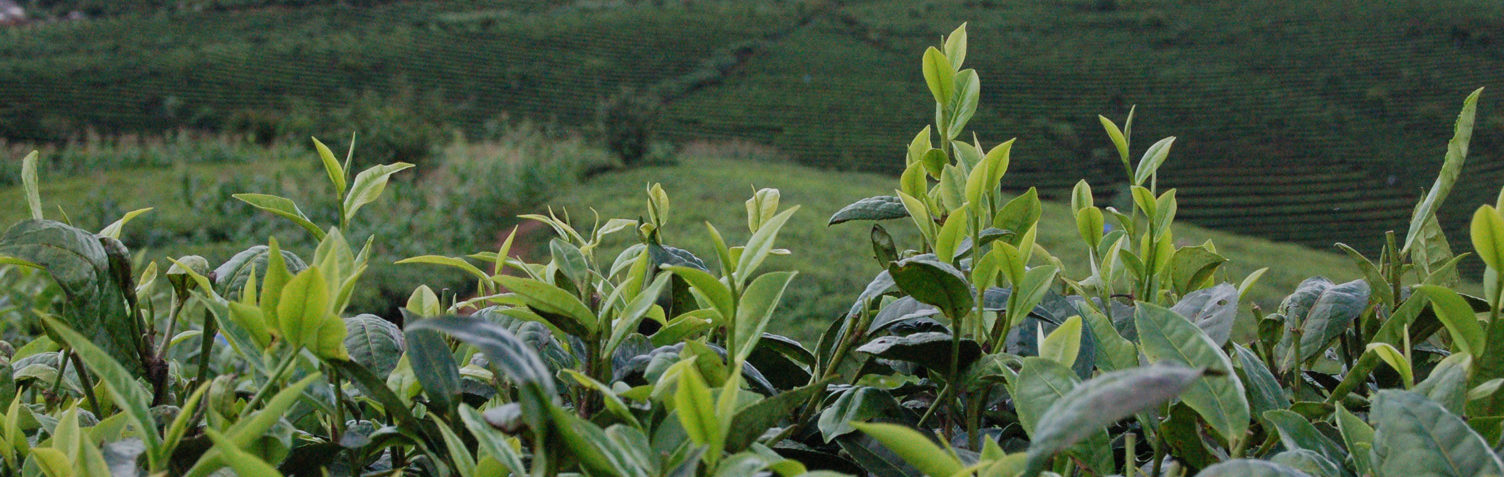
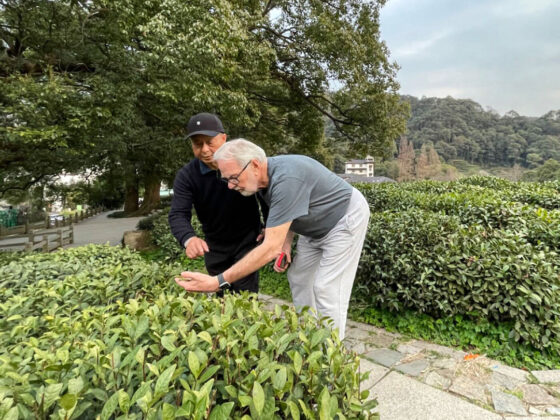
Da Fo Long Jing tea farms are scattered in the middle of the hilly and mountainous area of Xin Chang County with an altitude of 200-900 meters. The soil is a blend of yellow sand and a deep layer of the low acid soil. This region enjoys subtropical monsoon climate, mild and wet, with affluent rainfall. Thanks to the warm early spring and late autumn, Da Fo Long Jing can be plucked for more than six months. The buds contain rich nutrition and subtleness due to the high humidity as a result of is closeness to the East Sea. High quality Da Fo Long Jing requires a picking of one plump bud to one or two leaves with the bud longer than the leaf. The following steps demonstrate the craftsmanship used in processing Da Fo Long Jing tea.

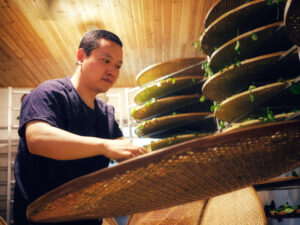
1. Withering- The leaves are placed on a bamboo sieve, in ventilating room to get rid of the moisture.

2. Frying- The fresh leaves are hand fried in a wok. The main movements include scratch, shake, put up, and press down. The tea leaves are made flat thus reducing 70% of the water.

3. Cooling- The just-fried leaves are put aside on the bamboo sieve, letting the water inside penetrate outside.

4. Second Fry: The leaves are fried again with the five following movements including push, buckle, swing, press, and grind.

bigbuddha-13.jpgbigbuddha-9.jpgbigbuddha-51.jpgbigbuddha-4.jpgbigbuddha-10.jpgbigbuddha-11.jpgbigbuddha-14.jpgbigbuddha-17.jpg
Buy Da Fo Long Jing


Site Map: