Early Spring Green and Yellow Tea Tour

Our Early Spring Green and Yellow Tea Tour (March 22 – April 3) will focus on Green teas with side trips to visit Yellow and Black teas that are harvested early in the Spring.  Check out the detailed itinerary below!

Tour date: March 22-April 3, 2010 (exact dates subject to change)
Duration: 13 days in China
Tour cost: $3,500
Single room supplement: $635
Minimum deposit: $1,500 (refundable until 60 days prior to departure)
Tour cost includes:
All local travel, all meals, all hotels, and all entry fees to events/museums from March 22 to April 2 (accommodations for the night before the tour starts are not included)
Tour cost does not include:
Airfare to and from Shanghai, visas, immunizations, or tips

Day-By-Day Itinerary

To be on time for the beginning of this tour, please plan to arrive in Shanghai no later than Sunday, March 21, 2010.

Day 1 (March 22): Daytrip to the Great Tang Dynasty Tribute Tea Museum (Purple Bamboo)
Twenty minutes from the hotel, you’ll drive into the beautiful bamboo forest that surrounds Changxing.  Our first stop is the Great Tang Dynasty Tribute Tea Museum, a stunning monument to tea built as a replica of the Tang Dynasty’s imperial tea factory (8th Century).  Then we’ll have lunch with our Purple Bamboo master’s family.  He will take you on a hike deep into the forest and up into his ancient Tang-Dynasty-era tea gardens on Gu Zhu Mountain.  You’ll see how Purple Bamboo is made in his small factory.

Day 2 (March 23): Daytrip to An Ji (An Ji Bai Cha)

Day 2 is all about An Ji, an area famous for its green teas (An Ji Bai Cha) and a thriving bamboo industry.  You’ll meet a tea master who will help you judge different types of An Ji tea, learn how to make An Ji Bai Cha, and have lunch with him in his countryside tea garden.  You’ll taste a variety of bamboo shoot dishes prepared in different ways.  Then we’ll drive through the bamboo forest where much of the film “Crouching Tiger, Hidden Dragon” was filmed!  A tea master will hike with us up the mountain to visit the mother bush of An Ji Bai Cha.  If time permits, Zhuping will help you shop for organic bamboo products in nearby shops.  We’ll dine in style at a gourmet tea house, where much of the food is prepared using tea.

Day 3 (March 24): Daytrip to Suzhou (Bi Luo Chun)
Today you’ll visit Suzhou and our Bi Luo Chun master, whose tea garden rests on Dong Ting Mountain, an island in the middle of Tai Lake.  Our tea master will show you how he produces this famous tea entirely by hand, and treat you to a special lunch prepared on the island.  You’ll have a chance to pick some tea as a souvenir.  The tea garden is full of flowering fruit trees — you’ll learn how these trees contribute to the flavor and aroma of Bi Luo Chun.

Day 4 (March 25): Daytrip to Yi Xing (Yixing Pottery)
On Day 4 we shift gears from tea to teaware.  We’ll visit Yi Xing, a city bordering Tai Lake and famous for its pottery.  You’ll meet master potters and artists who will show you how to appreciate and use this type of teapot, and they will make a pot in front of you.  You’ll also have a chance to walk through the Yixing museum and visit the ancient kiln where pots used to be fired.  If you love Yixing pottery (we do!) this is the place for you.  Yixing was famous during the Tang Dynasty for its Tribute Tea, called “Yang Mu Cha.”  We’ll try the local green and black tea while we’re here.

Day 5 (March 26): Daytrip to De Qing County (Mo Gan Huang Ya)
Learn about Mo Gan Huang Ya, a rare yellow tea grown in Zhejiang.  Only a few older countryside tea masters know how to make this tea!  You will meet Wang Qiang Zhen, our Mo Gan Huang Ya master, who has gained notoriety not only by being the best in the countryside, but also because she’s a woman in a traditionally male-dominated industry.  After our meeting, we will visit a wetlands environmental area in Da Jing that’s famous for birdwatching.

Day 6 (March 27): Daytrip to Lu Yu’s Tomb in Miao Xi Temple
Today we go to visit Lu Yu’s Tomb at Miao Xi Temple in Huzhou.  Tea lovers from across China visit the temple to pay their respects to Lu Yu.  Lu Yu, who is considered China’s “Tea Saint,” is the author of the “Cha Jing,” the first book on tea and tea culture written in the 8th Century.  Then we’ll drive to Nanxun county, an incredibly beautiful place lined with canals and renowned for its affluence during the Qing Dynasties.  Merchants in Nanxun built their wealth in the silk trade.  Wealthy families built houses using architectural techniques that are hard to find elsewhere in China.

Day 7 (March 28): Changxing to Hangzhou (Shi Feng Long Jing)
We’ll leave Changxing and make a short move to Hangzhou, a beautiful city that’s popular with Chinese and foreign tourists alike.  Hangzhou is known as the Tea Capital of China.  You’ll stay in a hotel near West Lake.  You’ll visit Mr. Weng Shang Yi, our widely respected Shi Feng Long Jing master, and witness the tea harvest at his gardens.  Then it’s off to the Hangzhou Tea Museum to meet a famous tea master from the International Tea Culture Institute.

Day 8 (March 29): Daytrip around West Lake in Hangzhou (Temples and Silk)
Today we’ll visit other parts of West Lake, which was the capital of China during the Song Dynasty.  It’s also one of the most important cultural sites in China, and has an ancient Buddhist temple and pagoda.  Here you will learn about how tea and Buddhism are intertwined.  In the afternoon, Zhuping will guide you through the wholesale silk market and Song Dynasty streets.  You’ll drink different kinds of tea today enjoy tea-inspired dishes in an authentic teahouse.

Day 9 (March 30): Hangzhou to Yellow Mountain City
We depart early in the morning for a bus ride to Anhui Province.  Yellow Mountain City is an artists’ town with a famous shopping street rebuilt from the Song Dynasty.  The street is lined with family museums (old family homes) where you can see how wealthy Chinese used to live during the Qing Dynasty.  It also has old shops where you can find local art, sweets, handicrafts, jewelry, tea, and other goods.  This is one of Zhuping’s favorite places to see ancient architecture and shop for traditional Chinese goods at reasonable prices!  You will meet our Huang Shan Mao Feng’s tea master, Master Wang Fang Sheng.

Day 10 (March 31): Daytrip to Mr. Wang’s Factory (Huang Shan Mao Feng)
Today we’ll visit Mr. Wang Fang Sheng, the tea master behind our Imperial and Premium Huang Shan Mao Feng, at his factory to see how he produces the tea by hand.  He will explain how to judge the different grades of Huang Shan Mao Feng.  We’ll be back in a couple of days to hike up the mountain into his tea gardens.

Day 11 (April 1): Daytrip to Qimen (Keemun)
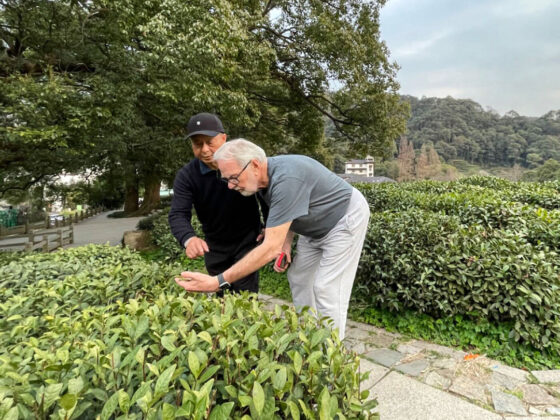
On Day 11 we’ll take a break from green tea and head to Qimen to visit the organic, high-mountain keemun tea gardens.  You’ll study the “Xiao Zhu Ye Zhong” tea bush, which Mr. Wang uses to make our keemun teas.  Mr. Wang will explain the history of his tea and drink it with you to show you how to judge its different grades.  We’ll also have a chance to drink the Queen’s Keemun, named in honor of the Queen of England.

Day 12 (April 2): Daytrip to Yellow Mountain
We’re ending our tour of the countryside on a high note.  Today you’ll hike up Yellow Mountain, perhaps the most famous mountain in China, and the highest mountain on the East side of China.  Yellow Mountain is to China what Yellowstone National Park is to America.  Artists have painted this mountain for hundreds of years.  In addition to great views, Chinese climb Yellow Mountain to bring good luck and energy.  For dinner we’ll enjoy President Hu Jintao’s favorite dish (he’s from the area) in a restaurant that features ancient art and sculpture, some of which dates back to the Tang Dynasty.

Day 13 (April 3): Shanghai
Whew!  It’s time to go home.  We’ll board the bus in the morning and head back to Shanghai.

Be Prepared
Touring the Chinese countryside is physically demanding. On this tour, be prepared to walk, hike, and travel by bus and bamboo boat.

Be Flexible
Over the past several years we have learned that plans in China are always subject to change. Flexibility is key, especially in the countryside where few foreigners have ventured! We appreciate your flexibility, and will do everything possible to ensure that this tour exceeds your wildest expectations. Prepare to have your socks knocked off!

admin - Website design by Creative Slice Green web design