Puer teas are elemental and mysteriously dark, fermented teas which are robust, earthy, rich and grounding. Puer is often a favorite tea of the truly dedicated tea drinker. This aged tea usually begins with a variety of leaf from exceptionally broad-leaved tea trees. This tea either left loose or compressed into cakes is then permitted to retain barely enough moisture content that the tea continues to ferment slowly over time. For this reason, puer is best stored open so that oxygen can continue to refine the tea.
There are two general types of puer: Shu (black, or cooked) and Sheng (green, or raw). The raw or Sheng (green) puer is made from mao cha this is lightly steamed and pressed into cakes. It is the sheng puer that demonstrates the miracle of puer. The microbes present in the mao cha that are not destroyed during sun drying work their magic and over 8 to 10 years until raw puer tea is transformed to cooked, green to black. It is the sheng that is most valuable over time and starts to reach is full maturity after around thirty years.
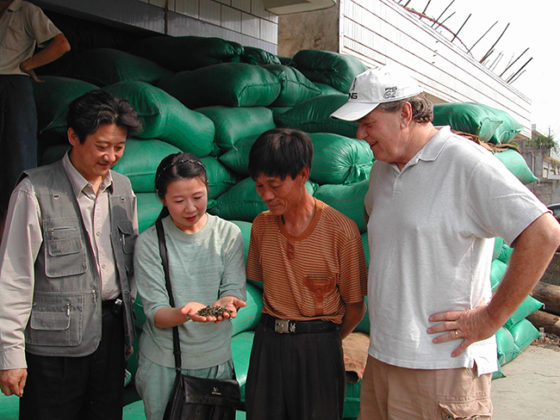
Shu, or cooked/black puer is more complicated. In 1973, because of a shortage of old cakes caused by the destruction of all things old during the Cultural Revolution, a process was developed for uniformly speeding up the aging process. This process has been well guarded in the past but is relatively simple, but not without skill. Large piles of maocha are wetted and then covered with a large canvas cloth, creating a kind of composting effect. The water drains off as does some of the natural moisture through the weight of the pile. Inside of the pile heat is produced. The pile becomes a rich environment for microbes that thrive in the tea leaves of the Yunnan rain forest.
The tea master’s skill comes into play when the pile needs to be turned. The turning needs to come at the right time, and there are clumps of growth that occur at the bottom of the heap and must be broken up and evenly distributed throughout the pile. When to turn and the attention paid to the details of turning are critical, so that the pile adds a pleasant fragrance to the tea. A poor level of skill turns the heap into an unkempt barnyard smell, flatteringly called ‘earthy’ in the West, and ‘old house smell’ in China. After the the tea is cooked it is sorted for grade, and then lightly steeped and pressed into cakes, bricks, etc. Read more...
This tea is infused with local Yunnan herbs called Nuo Mi Xiang Nen Ye which means "Sweet Rice Tender Leaves." The herb resembles mint with small, fingernail-sized leaves. People of the Dai Minority, who live in Southern Yunnan close to the rainforest, use this herb a lot to cool down during hot, humid days.
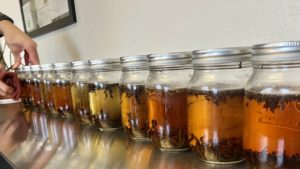
This tea has a clean, sweet aroma with none of the compost flavor of cheaper, commercial black puer. It brews up clear and red like wine, with a soft, smooth, rich flavor that fills the mouth. Right away you will taste black puer's character. This is a wonderful puer to take with you when you travel, to enjoy and to help soothe and settle your stomach.
When Lu Yu wrote his famous book about tea 1200 years ago, he mentioned that the best tea bushes had purple tea buds. This type of tea bush was recently discovered in Teng La, a small area within Jing Mai in southern Yunnan province. The soil and climate of this area is perfectly suited to the purple tea bushes, producing a rich, floral aroma unmatched by tea grown in other areas. The aroma and flavor linger in the mouth much longer than with other puer teas. The rich amino acids and antioxidants create a smooth, mild flavor that is easy to drink all day.
When brewed, this tea shares a lightly sweet aroma. The color of the liquid resembles fresh apricots and is very clear and clean; there is no murkiness or dust. This tea's mao cha comes from the Lin Cang tea area in west Yunnan. The mao cha from this area is very robust, giving a very strong personality to the finished puer. The flavor covers your whole mouth and creates a long finish. After a few cups, you can easily find a smooth lightly sweet flavor on the back of your tongue and throat.
This tea has a light aroma and rich, smooth flavor with a long finish through multiple infusions. The liquid is light and clear, and the infused leaves are the color of bamboo leaves. You can feel the sweetness of the tea in your throat after a few sips.
The leaves for this cake were picked early in the Spring. The buds and leaves are thick, which contributes to longer infusions. The aroma is complex and rich with hints of wild flowers, and the flavor has a slight bite with sour fruit notes that quickly turns sweet. Since this tea was picked in early 2011 during a period of severe drought, each tree produced fewer leaves but with a more concentrated flavor and aroma.